Manifest metadata review
Check package name, version, description, license, repository, homepage, keywords, author, engines, scripts and files fields.
Browser-side release file checker
Project files are checked locally in your browser. Dependency versions and vulnerability databases are not queried. Paste or upload package.json, pyproject.toml, composer.json, Cargo.toml, README and CHANGELOG files to check metadata, version, license, repository, homepage, scripts, README completeness, CHANGELOG structure and release checklist gaps before publishing.
Local release preflight
Use this combined browser tool for package manifests, README docs, CHANGELOG notes and release checklist review. Upload several files together or paste one file with its filename.
For pasted content, add the filename so the checker can distinguish manifests, README files and CHANGELOG files.
Project files stay in this browser tab. This checker does not upload files or call package registries.
Release file check results will appear here
Upload package.json, pyproject.toml, composer.json, Cargo.toml, README or CHANGELOG files, paste one project file, or choose a sample to see local metadata, version, license, links, scripts, README, CHANGELOG, checklist and fix suggestions.
The local workflow combines manifest checks, README checks, CHANGELOG checks and release checklist review in one browser-only report.
Upload package.json, pyproject.toml, composer.json, Cargo.toml, README and CHANGELOG files together, or paste one file with its filename for a local release preflight.
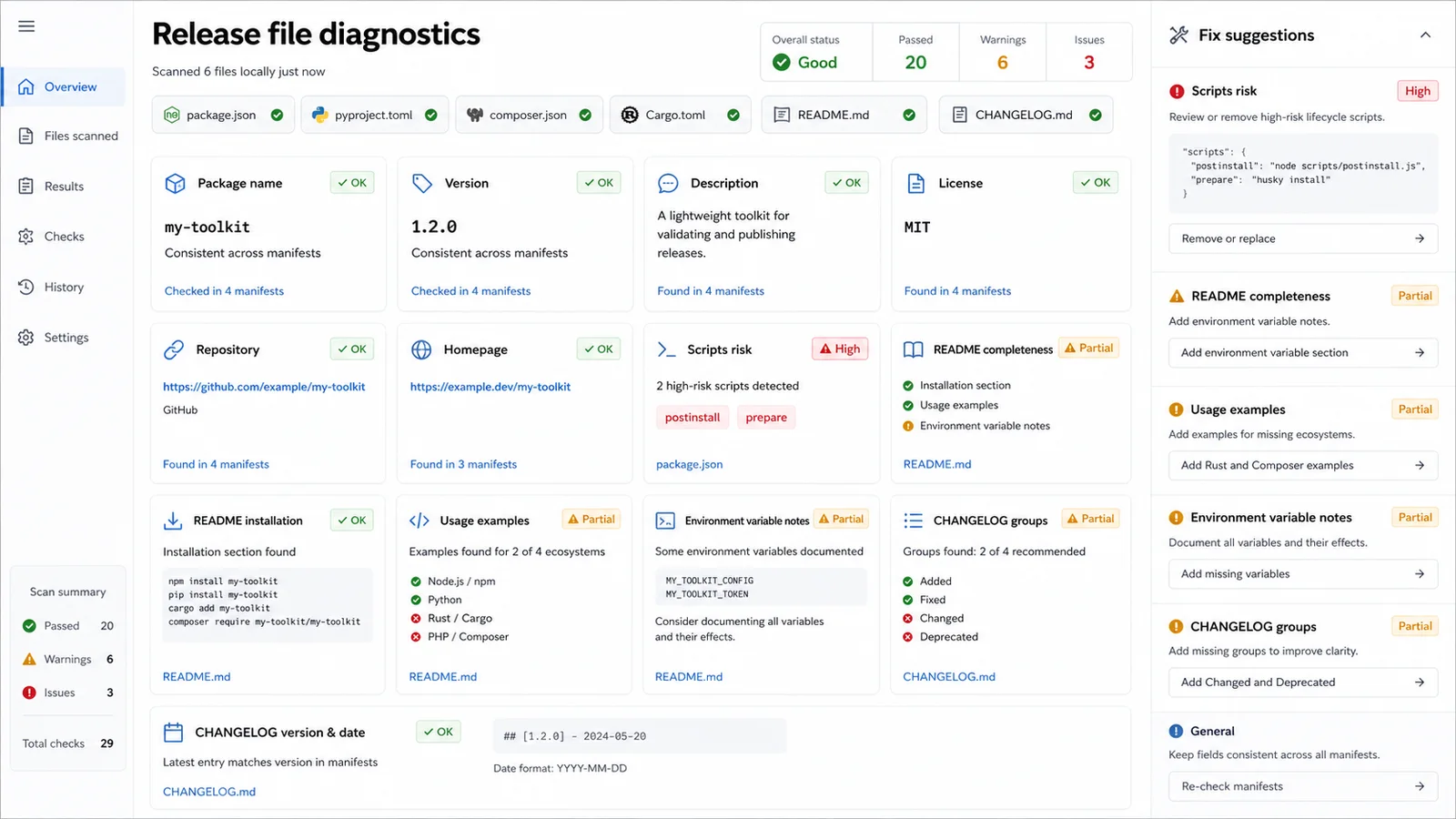
See project metadata summary, version checks, license presence, repository and homepage checks, script risk hints, README completeness and CHANGELOG completeness.
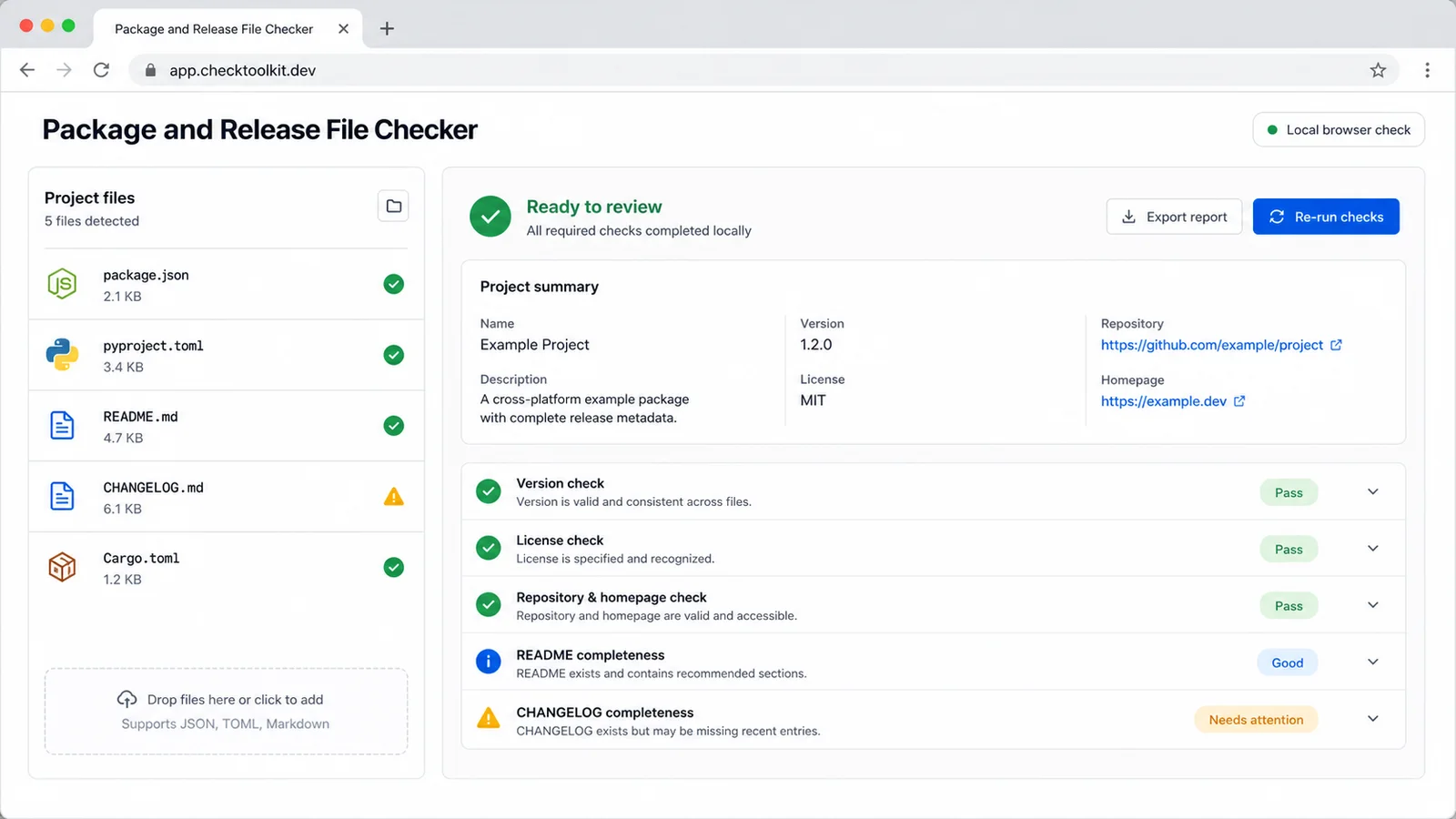
Turn the combined report into pre-release actions for package metadata, files allowlist, install docs, usage examples, environment notes and release notes groups.
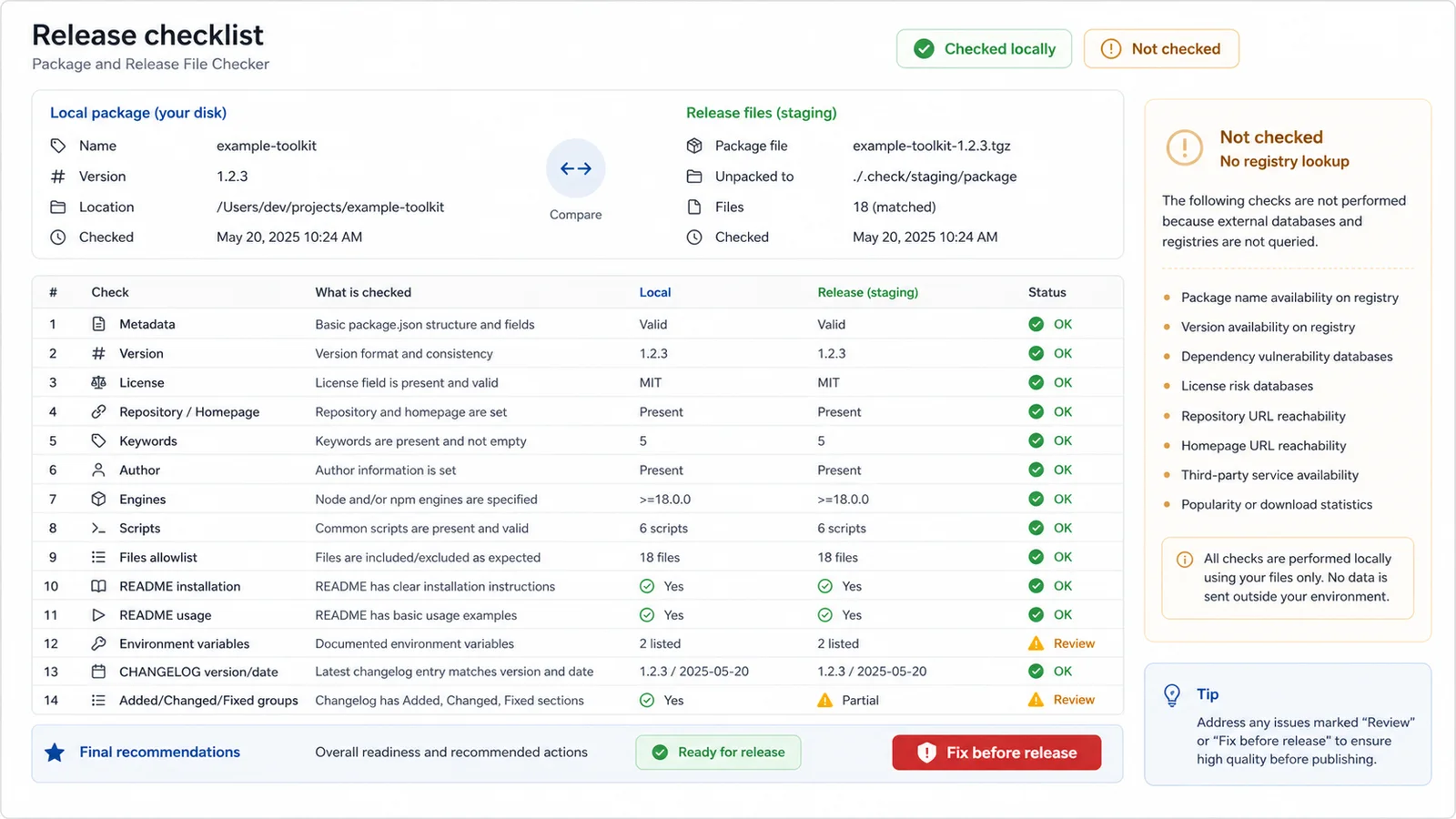
Use this local release checker when a package is ready to publish but the release files still need a fast, privacy-friendly pass.
Check package name, version, description, license, repository, homepage, keywords, author, engines, scripts and files fields.
Review package.json, pyproject.toml, composer.json and Cargo.toml with one local tool instead of splitting the workflow across small pages.
Look for installation instructions, usage examples and environment variable notes so users know how to start.
Check release version headings, ISO-style dates and Added, Changed and Fixed groups for scan-friendly release notes.
The tool explains that registry name availability, dependency freshness, vulnerability databases and legal license judgments are outside this local check.
Uploaded files and pasted project text stay in the browser while the checker parses and summarizes release readiness.
This is a practical preflight for files you already have. It helps catch missing release information before the final registry command.
Add the manifest, README and CHANGELOG files you plan to ship. For pasted content, include a filename such as package.json or CHANGELOG.md so detection is more accurate.
Start with package name, version, description, license, repository, homepage, keywords and maintainer fields, then review README and CHANGELOG completeness.
The checker is intentionally conservative: it flags missing fields and risky scripts, then lets your project policy decide what is required.
Review reportUse the suggestions to update manifest fields, add install and usage docs, explain environment variables and align CHANGELOG version, date and groups before publishing.
Answers about privacy, accepted files, accuracy and the limits of this local release checker.
It reads pasted text and uploaded text files such as package.json, pyproject.toml, composer.json, Cargo.toml, README.md and CHANGELOG.md. The checks run locally in the browser.
No. It does not query npm, PyPI, Packagist, crates.io or vulnerability databases. It only parses the files you provide and reports missing or risky release information.
No. It can tell whether a license field or license-like value exists, but legal compatibility and policy decisions need your own review.
It uses a lightweight browser parser for common pyproject.toml and Cargo.toml fields. Use your ecosystem's official build or publish command for final validation.
Release readiness usually depends on the whole file set, not one manifest field. Combining these checks helps catch missing documentation and release-note gaps before publishing.
Paste or upload the release files, review the local checklist, then update the project before publishing.
Local file parsing only. Registry, dependency and vulnerability databases are not queried.