robots.txt grouping
Review User-agent groups, Allow and Disallow rules, Crawl-delay values, duplicate rules, empty rules and invalid robots.txt lines.
Free Robots and Sitemap Checker
Paste robots.txt, sitemap.xml or sitemap index content into the Robots and Sitemap Checker to identify the file type and review common search crawling risks in one browser-side report. It combines robots.txt syntax review and sitemap XML checks, but it does not fetch a domain or crawl your site.
Browser-side crawl-file audit
The Robots and Sitemap Checker detects robots.txt, sitemap.xml or sitemap index content, then checks rules, XML structure, URLs, duplicate entries, lastmod dates and dangerous crawl-blocking patterns locally.
Your pasted content stays in this browser tab. The Robots and Sitemap Checker does not request a live URL, crawl your domain or upload private staging files.
Robots and Sitemap Checker results will appear here
Paste or upload robots.txt, sitemap.xml or sitemap index content to see detected type, rule groups, blocked paths, sitemap URLs, URL counts, duplicate URLs, invalid loc values, lastmod warnings and repair suggestions.
Issues
0
Fail
0
Review
0
Pass
0
The Robots and Sitemap Checker keeps robots.txt syntax review and sitemap XML validation together, because crawl mistakes often involve both files.
Paste or upload raw robots.txt, sitemap.xml or sitemap index content. The Robots and Sitemap Checker identifies the input type and runs the matching browser-side checks without fetching a domain.
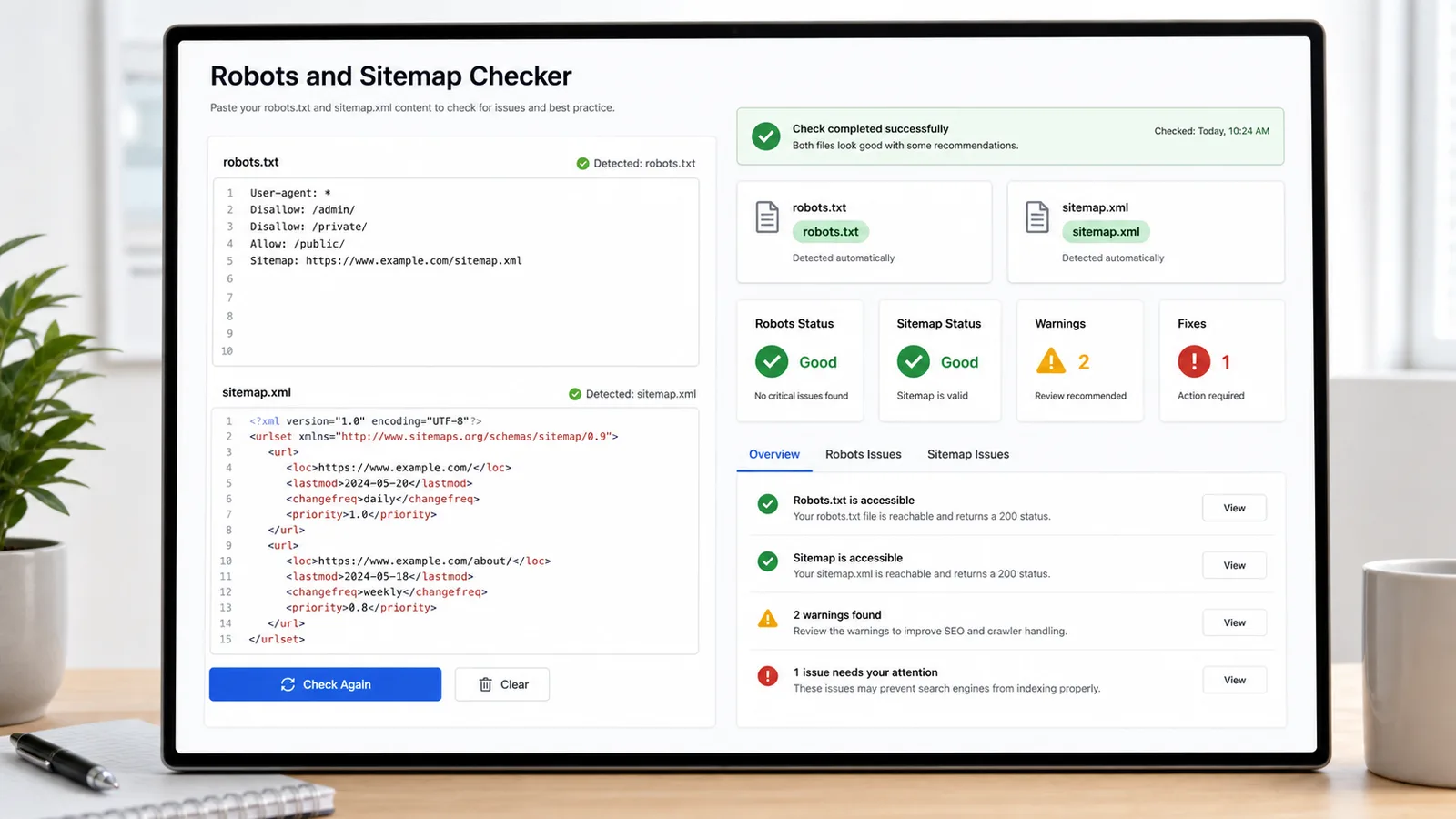
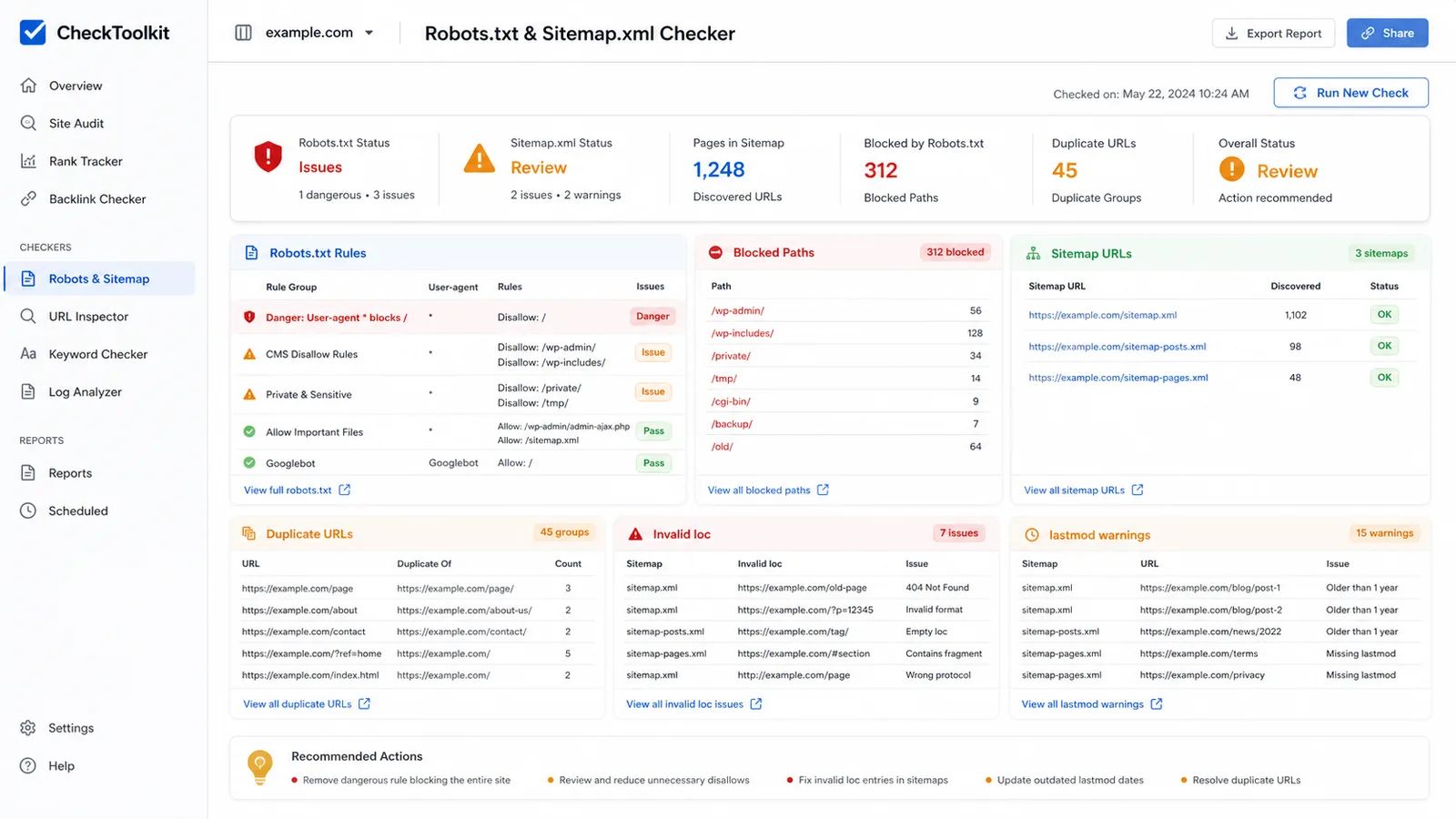
The Robots and Sitemap Checker shows robots rule groups, blocked paths, Sitemap directives, URL counts, duplicate URLs, invalid loc values, lastmod warnings and dangerous User-agent rules.
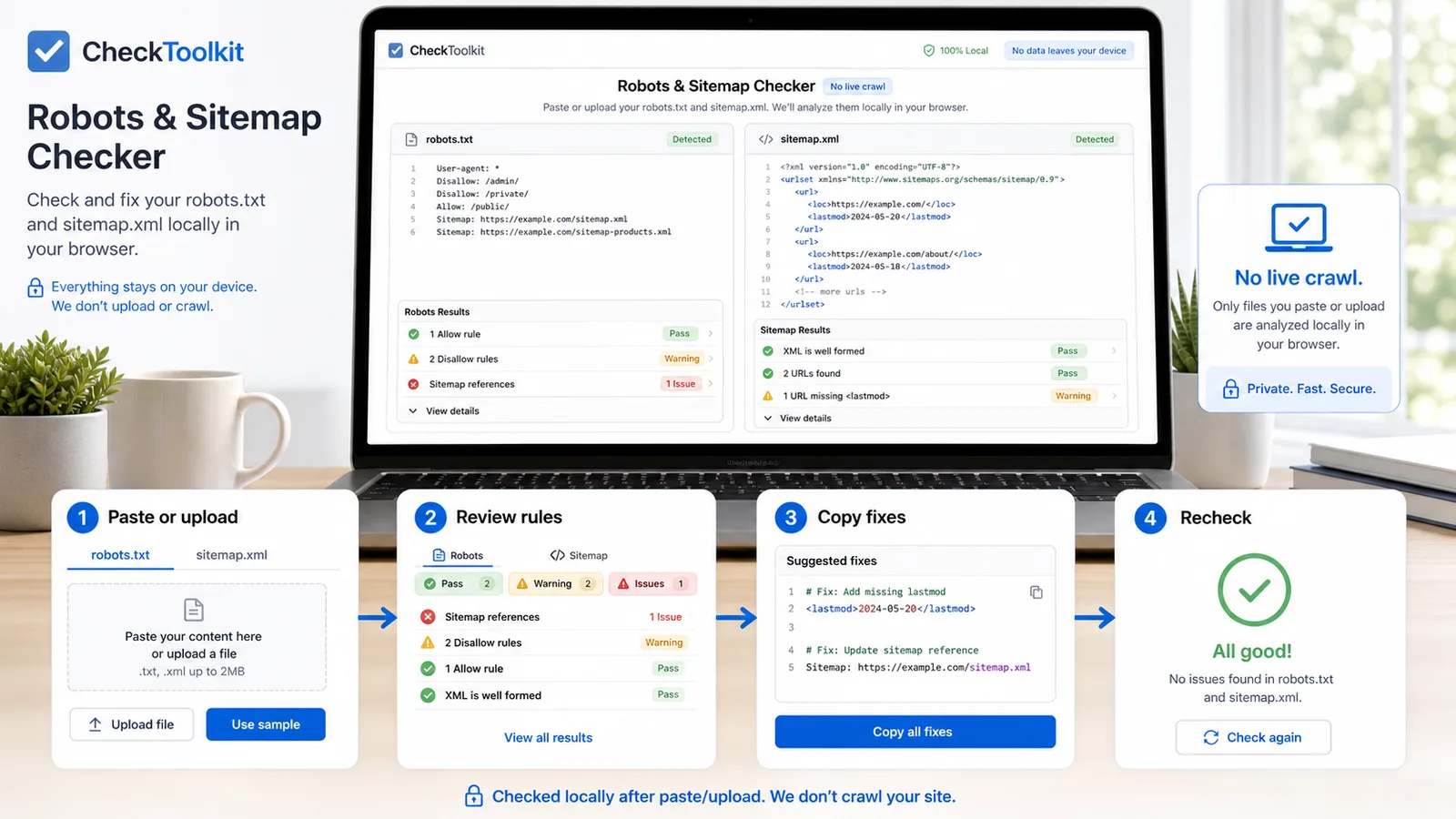
Copy the Robots and Sitemap Checker suggestions, update the file in your CMS or repository, then paste the revised content again before launch or handoff.
Use the Robots and Sitemap Checker when a crawl-related file needs quick QA before a release, migration, staging handoff or CMS update.
Review User-agent groups, Allow and Disallow rules, Crawl-delay values, duplicate rules, empty rules and invalid robots.txt lines.
Flag User-agent: * with Disallow: / so a staging rule is less likely to block the full public site by accident.
Check whether sitemap XML parses cleanly and uses urlset or sitemapindex as the root element.
Find empty loc values, non-HTTP loc values and duplicated canonical URLs before the sitemap is submitted.
Spot lastmod values that do not look like YYYY-MM-DD or a clear ISO date-time value.
Run the Robots and Sitemap Checker in the browser for drafts and staging files without uploading content or crawling URLs.
The Robots and Sitemap Checker is designed for pasted or uploaded file content, so it is a stable preflight for repositories, CMS exports and staging handoffs.
Copy the raw robots.txt, sitemap.xml or sitemap index content into the Robots and Sitemap Checker, or upload a .txt or .xml file from your device.
Start with failures such as invalid XML, empty loc values, invalid loc URLs and User-agent: * with Disallow: /. Then review duplicate rules, Crawl-delay values, repeated URLs and lastmod warnings.
The Robots and Sitemap Checker does not test server status, robots file discovery, sitemap submission state or live search engine behavior. It checks the content you provide.
Review reportCopy the repair suggestions, update your robots.txt or sitemap generation logic, and run the Robots and Sitemap Checker again with the revised content.
For migrations, check the production robots.txt and each generated sitemap file separately before switching traffic.
Recheck fileAnswers about accepted input, privacy, limits, official sitemap rules, robots.txt interpretation and what the Robots and Sitemap Checker does not crawl.
You can paste raw robots.txt, sitemap.xml or sitemap index content. The Robots and Sitemap Checker detects the type from the content and runs checks for that file. It is not a domain lookup tool.
No. The Robots and Sitemap Checker only checks pasted or uploaded content in your browser. It does not request /robots.txt, crawl pages, submit sitemaps or verify server responses.
It checks User-agent groups, Allow and Disallow rules, Sitemap directives, Crawl-delay values, empty rules, duplicate rules, invalid lines and the high-risk User-agent: * plus Disallow: / pattern.
It checks whether XML parses, whether the root is urlset or sitemapindex, whether loc values are empty or invalid, whether URLs repeat, whether lastmod values look malformed and whether the entry count is over 50,000.
No. The Robots and Sitemap Checker catches common content-level problems, but search engine behavior also depends on live server access, redirects, HTTP status, canonical tags, page quality and crawler-specific rules.
Yes. The check runs in the browser tab, so the file content does not need to leave your device. Avoid pasting secrets into public crawl files anyway, because robots.txt and sitemaps are usually meant to be publicly accessible.
Paste the crawl file, review the report, copy the suggested fixes and recheck the revised robots.txt or sitemap.xml before launch.
Browser-side checks only; no domain crawl or live fetch.