DELETE and UPDATE guard
Flags DELETE or UPDATE statements that do not include a WHERE clause, because those are common before-run mistakes.
Browser-side SQL before-run review
SQL is checked locally in your browser. Queries are not executed and no database connection is used. Paste the SQL you plan to run into this SQL Query Safety Checker to combine SQL Checker, SQL Safety Checker, SQL Before Run Checker, DELETE UPDATE Checker and SQL Risk Checker workflows in one static browser tool.
Local SQL Query Safety Checker
This local SQL checker uses browser-only static heuristics to flag obvious before-run risks: DELETE or UPDATE without WHERE, DROP, TRUNCATE, multi-statement execution, SELECT *, missing LIMIT, hardcoded passwords or tokens, production-looking names, dangerous comments, string-concatenated variables, broad conditions and transaction reminders.
SQL is checked locally in your browser. Queries are not executed and no database connection is used.
This is a static SQL risk review, not a parser with your real schema. Treat the report as a before-run checklist and confirm important changes in your own database workflow.
SQL safety results will appear here
Paste SQL to see SQL type, involved table names, dangerous operation alerts, WHERE checks, LIMIT checks, multi-statement risk, hardcoded sensitive information reminders, an execution checklist and fix suggestions.
Use this checker when a query needs a quick static safety pass before it reaches a database client.
Start with the query or short batch you are about to run. The checker keeps it in the browser and does not execute it.
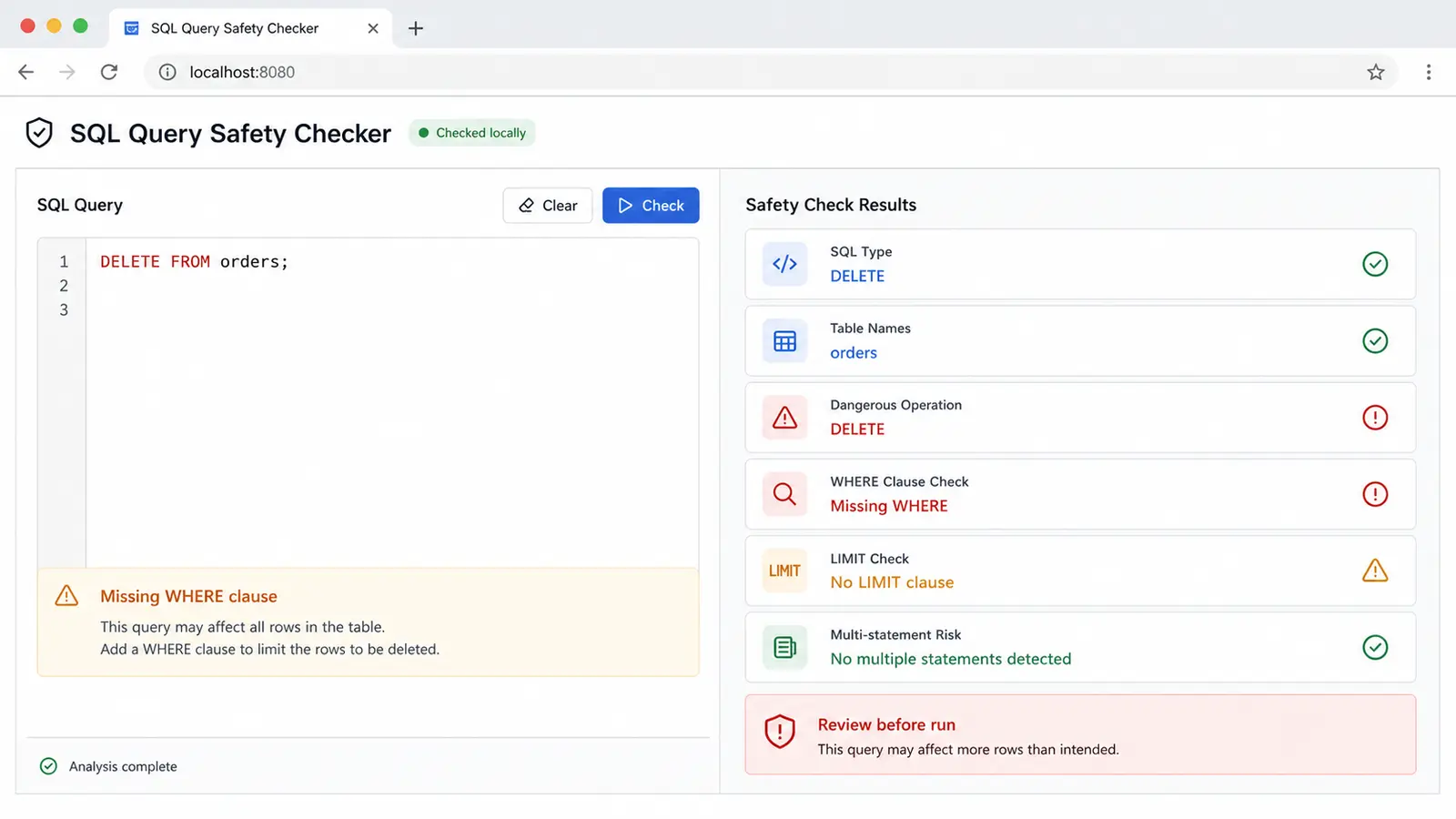
Check dangerous operations, WHERE status, LIMIT status, multi-statement risk, hardcoded secrets, production hints and broad conditions.
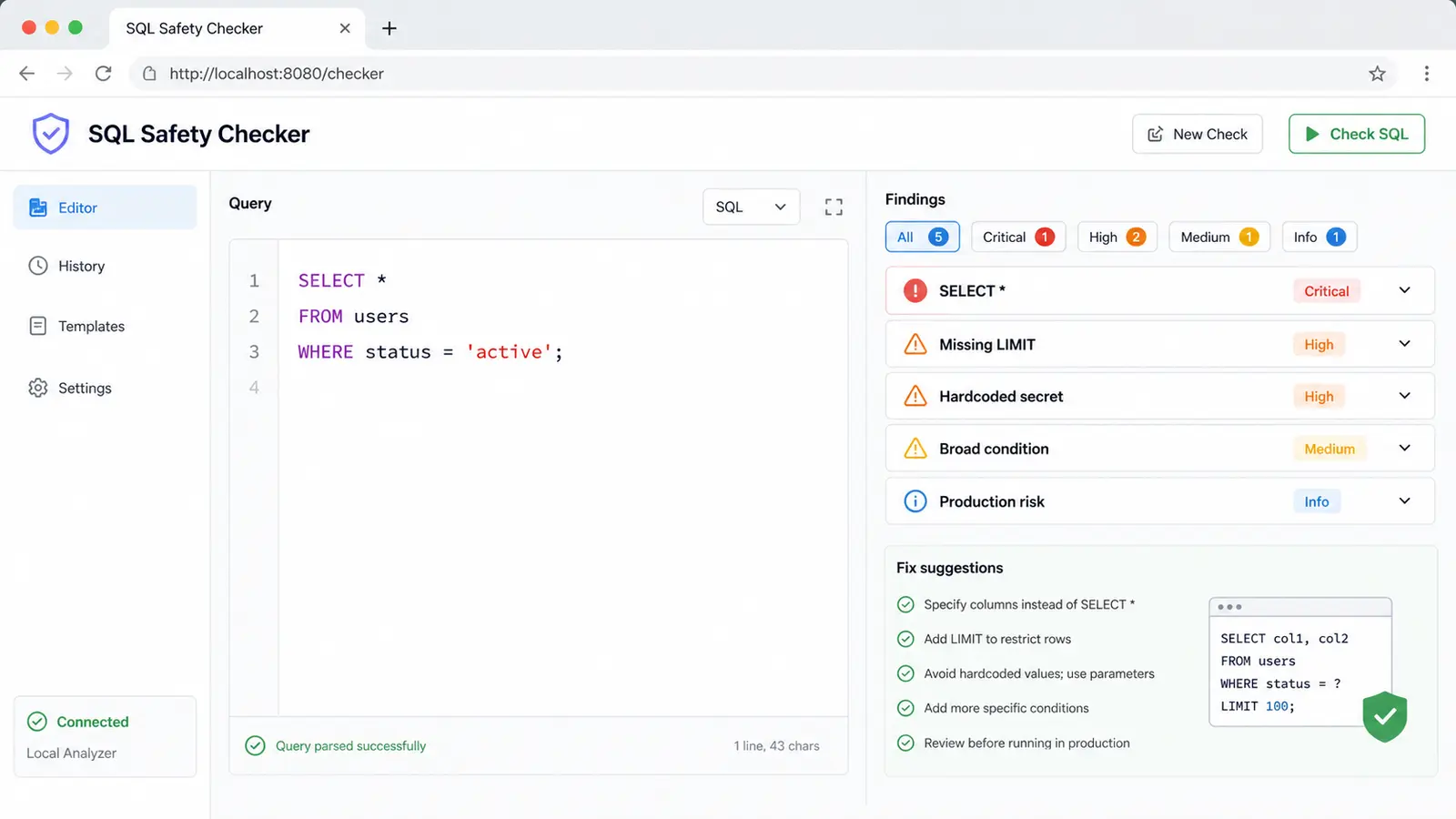
Turn the report into a practical before-run checklist: preview rows, add guards, remove secrets, confirm the environment and plan rollback.
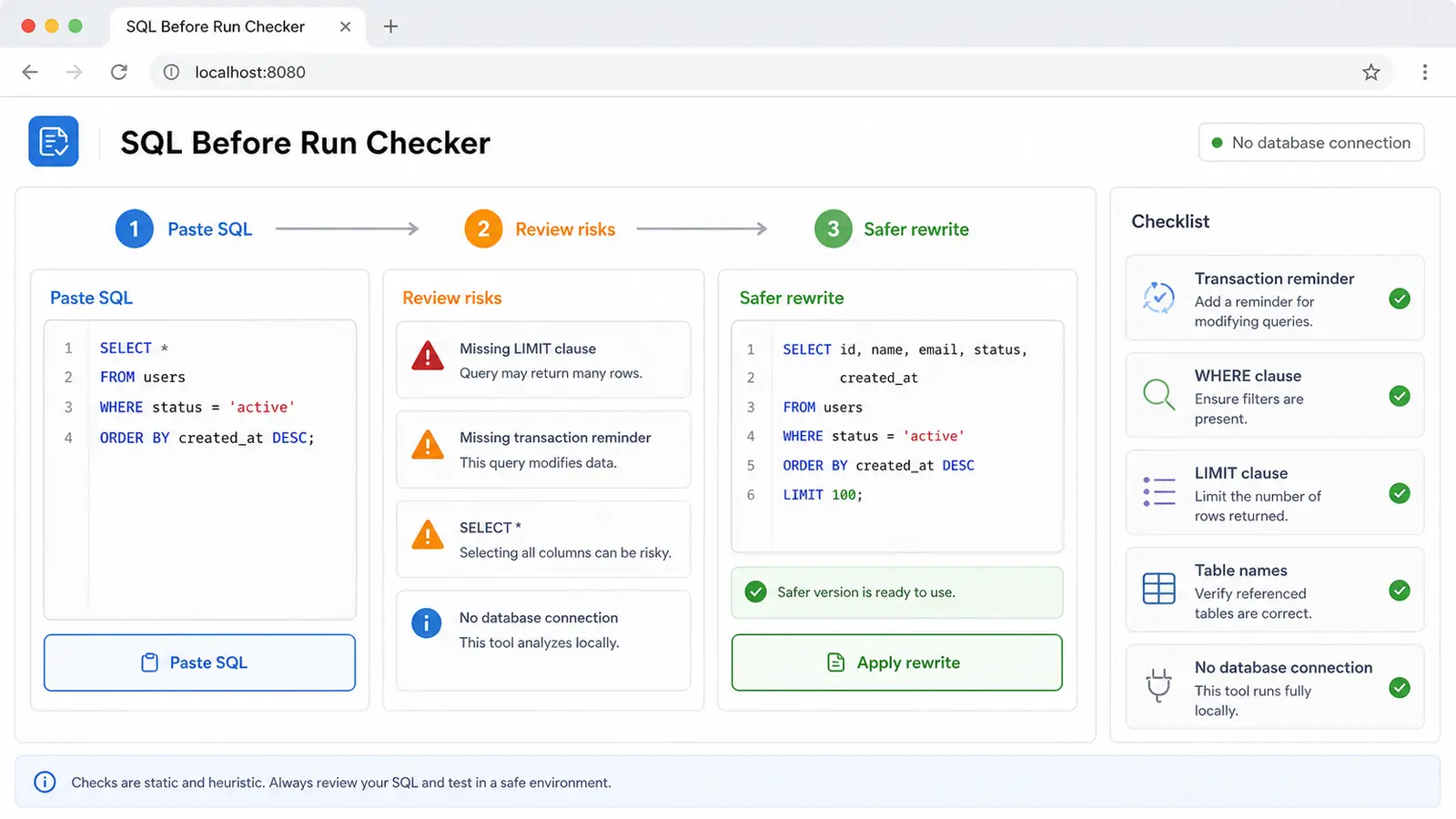
The SQL Query Safety Checker merges SQL Checker, SQL Safety Checker, SQL Before Run Checker, DELETE UPDATE Checker and SQL Risk Checker tasks into one local static review.
Flags DELETE or UPDATE statements that do not include a WHERE clause, because those are common before-run mistakes.
Highlights DROP and TRUNCATE so you can stop and confirm backups, migration plans and approval before touching data.
Looks for SELECT * and missing LIMIT patterns that may read more data than intended during manual checks.
Warns when password, token, secret or API key style values appear directly in SQL text.
Flags template interpolation, string concatenation signs and risky comments that can hide unsafe intent.
Summarizes SQL type, involved tables, WHERE, LIMIT, multi-statement risk, sensitive values and transaction reminders.
Use this checker as a lightweight static review step before a database client, migration console or admin panel.
Use the query you are about to run, including comments and semicolons. The checker keeps it local and uses static text rules only.
Stop on DELETE or UPDATE without WHERE, DROP, TRUNCATE, multi-statement batches, broad WHERE clauses, hardcoded secrets and production-looking names.
The checker cannot know your schema or permissions, so treat medium and low findings as reminders to verify row counts, backups and rollback.
Review warningsRewrite the query with specific predicates, explicit row guards, bound parameters and a transaction plan before running it in your real database workflow.
Answers about privacy, accuracy, accepted SQL text, limits and how to interpret the results.
No. SQL is checked locally in your browser. Queries are not executed and no database connection is used.
No. It is a static text checker for obvious before-run risks. It cannot know your schema, permissions, row counts, triggers, backups or production change process.
You can paste plain SQL text, one statement or a short batch. The tool is most useful for manual SELECT, UPDATE, DELETE, DROP, TRUNCATE, INSERT and ALTER review before running.
No. It does not do execution plan analysis, performance optimization scoring or index judgment because those require a database connection, real schema and runtime context.
No. It can flag obvious string concatenation or template interpolation signs, but it does not scan an application for SQL injection vulnerabilities.
Do not run the query as-is. Add a precise WHERE clause, split multi-statement batches, remove hardcoded secrets, confirm the target environment and plan rollback or approval before executing.
Paste SQL before running manual database changes, support fixes, admin scripts or one-off reporting queries.
Let the checker surface obvious static risks locally, then review the final query in your real database workflow.
Local static SQL checks in your browser.